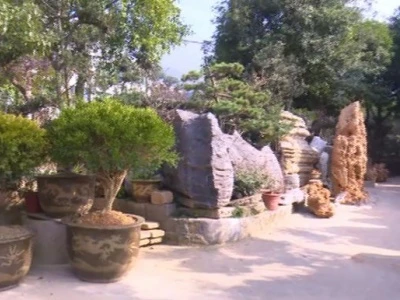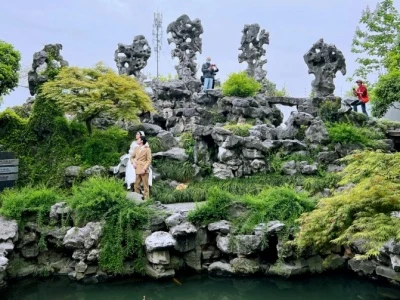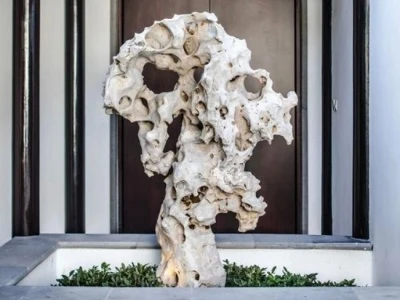
The physicochemical properties of Taihu stones are intimately linked to their formation processes and chemical composition. Composed primarily of limestone-specifically calcium carbonate-these stones are susceptible to dissolution by water containing carbon dioxide. Over the course of vast geological epochs, through the combined forces of wave impact and chemical erosion, they have gradually evolved into their unique, characteristic forms-defined by qualities of leanness, cragginess, openness, and permeability, as well as sinuous contours and rounded edges. This evolution serves as a striking manifestation of their distinct chemical characteristics.
In terms of physical properties, Taihu stones exhibit a rich palette of colors; while white and gray predominate, shades of blue-green, yellow, and black are also frequently observed. These variations in coloration are directly correlated with the specific environmental conditions under which the stones formed, as well as the nature of the impurities embedded within them. Regarding hardness, Taihu stones possess a Mohs hardness of 3, classifying them as relatively soft stone materials. This inherent softness renders them highly amenable to the sculpting forces of natural erosion and human craftsmanship, facilitating the creation of a diverse array of shapes and forms. In terms of density, Taihu stones typically range between 2.1 and 2.6 tons per cubic meter.
Furthermore, distinct variations in physical properties exist among different types of Taihu stones. "Water-borne" Taihu stones-specifically those quarried from the waters of Lake Taihu surrounding the Xishan (West Mountain) area of Dongting, Suzhou-are characterized by a firm, robust texture; compared to their "land-borne" counterparts, they exhibit greater hardness and density. The surfaces of these water-borne stones frequently feature intricate textures resembling rippling waves or fish scales-patterns that are remarkably diverse and ever-changing. When struck, they emit a clear, resonant ring, akin to the sonorous chime of a stone chime (qing). Conversely, "land-borne" Taihu stones possess a texture that is relatively less lustrous and refined than that of the water-borne variety, and they also exhibit slightly lower levels of hardness and density.